
Morning headaches can begin before you are fully awake or appear within minutes of getting out of bed. An occasional episode may follow poor sleep, dehydration, alcohol, or a tense jaw. When the pain keeps returning, the timing can also point toward migraine, sleep apnea, medication overuse, or another problem that deserves attention.
The hour on the clock does not identify the cause by itself. What matters is the pattern: where the pain sits, how long it lasts, what happened overnight, which symptoms come with it, and whether anyone else in the home feels unwell.
Morning headaches: the quick answer
The most useful clues are often found outside the headache. Loud snoring and daytime sleepiness raise concern about disrupted breathing during sleep. Jaw soreness suggests clenching or grinding. Thirst and dark urine support dehydration. Throbbing pain with nausea or sensitivity to light may fit migraine. A headache affecting several people in the same home can signal carbon monoxide exposure and needs immediate action.
- Usually less urgent: mild pain after a short night, missed fluids, alcohol, or neck and jaw tension that improves and does not keep returning.
- Worth a medical appointment: recurring or worsening pain, headaches that affect work or sleep, or symptoms of sleep apnea or medication overuse.
- Urgent: a sudden severe headache, new weakness or confusion, fever with a stiff neck, a headache after a significant head injury, or possible carbon monoxide exposure.

What the timing can—and cannot—tell you
Head pain on waking can be a primary headache, such as migraine or tension-type headache. It can also be secondary to something else, including poor-quality sleep, teeth grinding, dehydration, a medicine-related problem, or exposure in the sleeping environment. The National Institute of Neurological Disorders and Stroke explains that headache types and triggers overlap, so one symptom is rarely enough for a diagnosis. For that reason, morning headaches should be interpreted alongside the symptoms and events around them.
Keep track of whether your morning headaches fade after you get up or continue into the day. Also note whether they occur only at home, only after certain drinks or medicines, or alongside snoring, dry mouth, jaw pain, nausea, vision changes, weakness, or numbness. These details are often more useful than simply rating the pain from one to ten.
7 clues that may explain morning headaches
1. Your sleep was short, broken, or off schedule
Too little sleep and poor-quality sleep can trigger tension-type headaches and migraine attacks in some people. Oversleeping or changing your usual bedtime and wake time can also disrupt a person who is sensitive to sleep changes. If morning headaches appear after late nights, shift work, travel, or repeated awakenings, sleep disruption may be part of the pattern.
Other signs of a strained sleep routine can show up elsewhere. For example, fatigue and stress are also among the common reasons an eyelid may keep twitching. That does not prove the two symptoms share one cause, but it is a reason to review sleep quality rather than looking only at the head pain.
2. You snore, gasp, wake with a dry mouth, or feel sleepy all day
Sleep apnea causes breathing to stop and restart during sleep. The repeated disruption can leave a person unrefreshed, and headache is one recognized symptom. The National Heart, Lung, and Blood Institute also lists loud snoring, gasping, daytime sleepiness, dry mouth, and frequent nighttime urination among possible clues.
Morning headaches do not prove that you have sleep apnea. Still, the combination becomes more meaningful if someone has noticed pauses in your breathing, you wake choking, or you struggle to stay alert during the day. Discuss that pattern with a healthcare professional; a sleep study may be needed to confirm or rule out the condition.
3. Your jaw feels tight or your teeth are sensitive
Bruxism means grinding or clenching the teeth while awake or asleep. Because sleep bruxism can happen without your awareness, morning headaches may occur with a tired or sore jaw, facial pain, tooth sensitivity, worn teeth, or dull pain around the temples.
The National Institute of Dental and Craniofacial Research notes that severe bruxism can cause headache, jaw symptoms, and tooth damage. A dentist can check for wear and tenderness. Avoid buying a one-size-fits-all solution based only on a headache; the right approach depends on what is actually happening.
4. The pain behaves like migraine or tension-type headache
Migraine can occur in the morning and often causes moderate or severe throbbing pain, sometimes on one side, with nausea or sensitivity to light and sound. Tension-type pain more often feels like steady pressure or a tight band on both sides of the head. Neck, scalp, or jaw tension may be present too.
These descriptions are clues, not a home diagnosis. Some attacks do not follow the textbook pattern. Because morning headaches can look different from one person to another, a diary can show whether they follow missed meals, stress, menstrual changes, irregular sleep, alcohol, or another repeatable trigger.
5. You are thirsty, your mouth is dry, or your urine is darker
Not drinking enough, sweating heavily, vomiting, diarrhea, fever, or alcohol use can leave you short of fluid by morning. Dehydration is a recognized headache trigger, although a headache alone cannot confirm it.
Look at the whole picture. Thirst, dry mouth, urinating less often, and concentrated urine support dehydration more than head pain by itself. Morning headaches after alcohol, heat, or stomach illness make fluid loss worth considering. Our guide to dark urine causes explains when concentrated urine may reflect low fluid intake and when a color change needs more attention.
If you have no medical reason to restrict fluids, regular hydration during the day is sensible. Do not force excessive amounts of water or assume every recurring headache is dehydration, especially when other symptoms are present.
6. Caffeine or headache medicine is part of the cycle
A delayed morning coffee can trigger withdrawal symptoms in someone who regularly consumes caffeine. At the same time, using medicine for headaches too frequently can contribute to medication-overuse headache, creating a cycle in which pain becomes more frequent or persistent.
The American Migraine Foundation explains that risk depends on the type of medicine and how often it is taken. Do not abruptly stop a prescribed medicine or make major changes on your own. Instead, record every medicine, dose, and headache day, then ask a clinician or pharmacist to review the pattern.
If morning headaches improve briefly after caffeine or pain relief but repeatedly return, that detail belongs in your diary. It may help a professional distinguish the underlying headache disorder from withdrawal or overuse.
7. Other people or pets in the home also seem unwell
Carbon monoxide is an odorless, colorless gas produced when fuels burn. Headache, dizziness, weakness, nausea, chest pain, and confusion are common symptoms of poisoning. Exposure can become especially dangerous during sleep because a person may not wake in time to recognize it.
Treat this as an environmental warning, not a wait-and-see symptom. If several people develop similar morning headaches, symptoms are worse inside a particular building, a carbon monoxide alarm sounds, or fuel-burning equipment may be faulty, move into fresh air immediately and contact local emergency services. Follow the CDC carbon monoxide safety guidance; do not go back inside until authorities say it is safe.
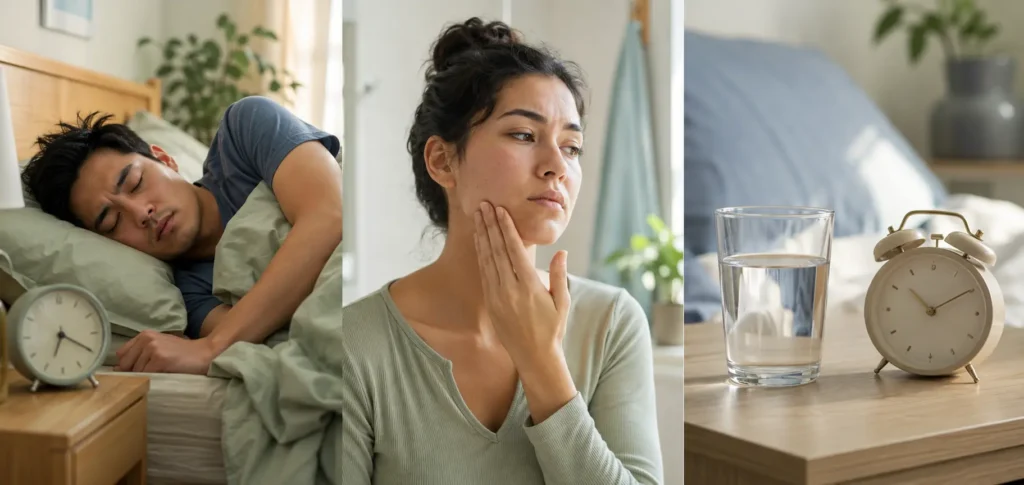
A simple pattern check before you guess the cause
When morning headaches recur, compare the details below rather than choosing a cause from timing alone.
| Pattern to record | Why it may help |
|---|---|
| Pressure on both sides versus throbbing on one side | May help a clinician compare tension-type and migraine features |
| Snoring, gasping, dry mouth, and daytime sleepiness | Raises the question of sleep-disordered breathing |
| Jaw fatigue, tooth sensitivity, or worn teeth | Supports a dental check for clenching or grinding |
| Thirst, darker urine, alcohol, heat, vomiting, or diarrhea | Provides context for possible fluid loss |
| Headache and medicine days | Helps identify a possible medication-overuse pattern |
| Symptoms improve after leaving the building | Can be an urgent environmental clue, especially if others are affected |
A diary is particularly useful when morning headaches happen several times a month. Record the date, bedtime, wake time, sleep quality, pain location, other symptoms, food and drink, caffeine, alcohol, medicines, and how long the pain lasts. Bring the record to an appointment rather than trying to interpret every entry yourself.
What may help safely at home
Low-risk steps can make morning headaches easier to track and may reduce common triggers:
- Keep a consistent sleep and wake schedule for a couple of weeks.
- Drink fluids regularly during the day if you have not been told to restrict them.
- Avoid skipping meals if that tends to trigger head pain.
- Notice whether alcohol or a major change in caffeine timing precedes the headache.
- Relax your jaw and avoid chewing gum if jaw muscles feel overworked.
- Check that carbon monoxide alarms are installed near sleeping areas and working according to the manufacturer’s instructions.
- Track pain-relief use rather than repeatedly increasing it without advice.
Do not use home care to delay an assessment when morning headaches are new, frequent, worsening, or accompanied by concerning symptoms.
When to book a routine medical appointment
Arrange a medical review if morning headaches keep returning, affect daily life, wake you from sleep, change from your usual headache pattern, or require frequent medication. Also make an appointment if you have signs of sleep apnea, persistent jaw or tooth symptoms, or a new headache after age 50.
When evaluating morning headaches, a clinician may ask about sleep, snoring, caffeine, alcohol, medicines, menstrual or hormonal patterns, stress, injuries, and family history. They may check blood pressure, perform a neurological examination, assess the head and neck, or suggest dental, vision, sleep, or other testing based on the pattern.
Do not assume routine high blood pressure is the cause simply because the headache occurs in the morning. High blood pressure is often silent. Our guide on high blood pressure and dizziness explains why measurements and accompanying symptoms matter more than guesswork.
When morning headaches need urgent help
Contact local emergency services or seek urgent medical care for:
- a sudden, extremely severe headache or a headache that peaks rapidly;
- new facial drooping, one-sided weakness, trouble speaking, confusion, fainting, a seizure, or severe balance difficulty;
- fever with a stiff neck, marked drowsiness, or a new rash;
- a significant head injury followed by headache, vomiting, confusion, or unusual sleepiness;
- severe eye pain or sudden vision loss;
- suspected carbon monoxide exposure, especially when several people are affected.
Sudden numbness is different from the brief positional tingling some people notice after sleeping on an arm. The guide to waking up with numb hands explains the pattern, but headache with new weakness, speech trouble, or facial drooping is an emergency.
MedlinePlus advises immediate help for a sudden severe headache and for headache with signs such as stiff neck, fever, confusion, loss of consciousness, or pain after a blow to the head. Do not drive yourself if you are confused, faint, very weak, or experiencing new neurological symptoms.
Frequently asked questions
Why do I wake up with a headache every morning?
Daily morning headaches can be associated with sleep apnea, bruxism, migraine, tension-type headache, medication overuse, caffeine withdrawal, or other causes. The regularity makes a medical review worthwhile, especially if the pattern is new or worsening.
Can sleep apnea cause a headache after sleeping?
Yes. Headache is a recognized symptom of sleep apnea, particularly when it appears with loud snoring, gasping, dry mouth, unrefreshing sleep, or daytime sleepiness. Symptoms alone cannot confirm sleep apnea; a healthcare professional may recommend a sleep study.
Are morning headaches caused by high blood pressure?
Usually, ordinary high blood pressure causes no clear symptoms. A very high reading with severe headache, chest pain, breathing trouble, confusion, weakness, or vision changes is different and needs urgent assessment. Checking a reading is more reliable than assuming head pain reveals blood pressure.
Can dehydration cause a headache when I wake up?
Dehydration can trigger headache in some people. It is more plausible when the pain follows low fluid intake, heat, heavy sweating, alcohol, vomiting, or diarrhea and comes with thirst, dry mouth, darker urine, or reduced urination.
How long should I track morning headaches?
Start recording them now and bring the diary to your next appointment. A week or two can reveal useful patterns, but do not wait for a diary to be complete if symptoms are severe, rapidly worsening, or accompanied by a red flag.
Bottom line
Morning headaches are a timing pattern, not a diagnosis. Sleep disruption, sleep apnea, jaw clenching, migraine, dehydration, caffeine changes, and medication overuse are possible explanations. Similar symptoms in several people can point to carbon monoxide and require immediate action. Track the surrounding clues, use low-risk measures where appropriate, and get recurring or changing pain assessed.
This article is for general educational information only and is not a substitute for professional medical advice, diagnosis, or treatment. Symptoms can have many possible causes. Contact a qualified healthcare professional if you are concerned, especially when symptoms are severe, persistent, new, or worsening. Seek urgent help for emergency warning signs.
Sources
- National Institute of Neurological Disorders and Stroke: Headache
- MedlinePlus: Headache
- National Heart, Lung, and Blood Institute: Sleep Apnea Symptoms
- National Institute of Dental and Craniofacial Research: Bruxism
- American Migraine Foundation: Medication Overuse Headache
- Centers for Disease Control and Prevention: Carbon Monoxide Poisoning Basics